

Node JS Architecture

A web developer, certified in Java. Pursuing a BCA in the third year and currently learning full-stack web development from Chaicode.
Node.js has rapidly become one of the most popular platforms for building fast, scalable, and real-time web applications. But what makes Node.js so powerful? The answer lies in its architecture.
In this blog, we'll dive deep into the Node.js Architecture, explaining how it works under the hood, why it's non-blocking, and how it handles concurrent requests efficiently. Whether you're a beginner or an intermediate developer, this article will give you a solid understanding of Node.js internals.
1. What is Node.js?
Node.js is an open-source, cross-platform, JavaScript runtime environment that allows you to run JavaScript code outside of the browser, typically on the server side.
It uses the V8 JavaScript engine to execute code and follows a non-blocking, event-driven architecture, which makes it ideal for building scalable network applications.
2. Why Node.js?
Single programming language (JavaScript) on frontend and backend
Fast execution using V8 engine
Asynchronous and event-driven
Ideal for I/O-heavy tasks (e.g., API, chat, file operations)
Large ecosystem via Node Package Manager
3. Overview of Node.js Architecture
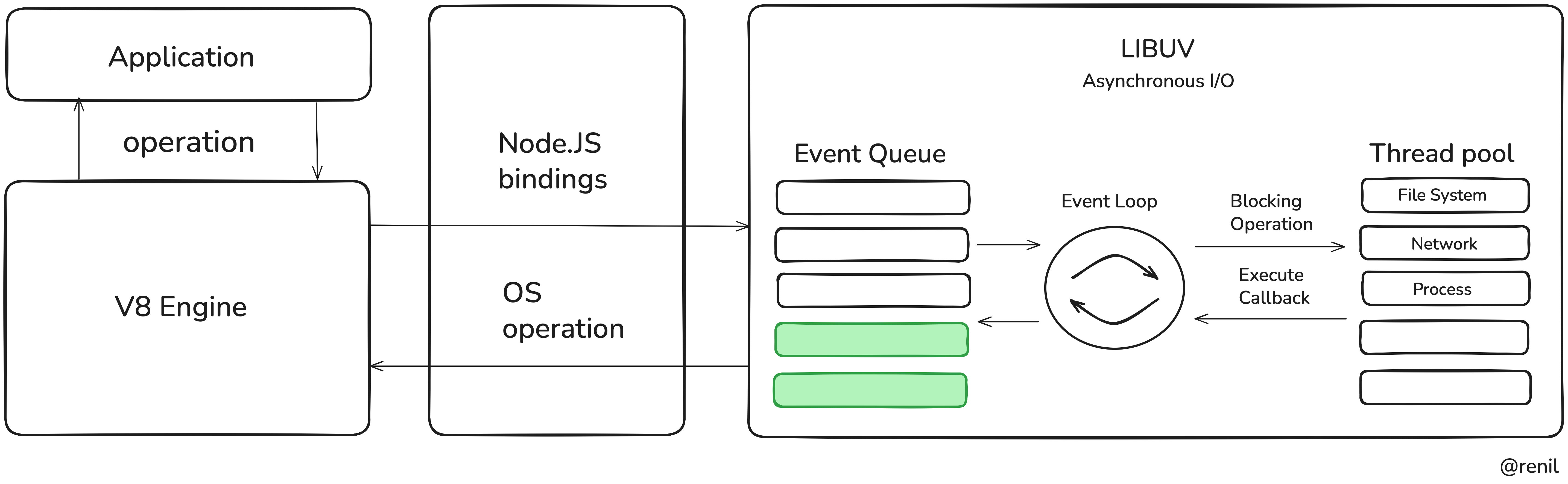
Node.js uses a Single Threaded Event Loop architecture that handles multiple clients concurrently. Unlike traditional web servers (like Apache), which use multiple threads for each client request, Node.js handles all requests using a single thread.
Here’s how it works:
All incoming requests are placed in an Event Queue
A single thread (the Event Loop) processes these events
Long-running operations (like I/O) are delegated to a Thread Pool
Once completed, callbacks are placed back into the queue for execution
→ This approach avoids the overhead of context switching between threads and makes Node.js extremely efficient.
4. Components of Node.js Architecture
▪️ Event Loop
The Event Loop is the heart of Node.js. It’s an infinite loop that picks events from the Event Queue and processes them. If the event has a callback, it will execute the callback.
Runs on a single thread
Handles non-blocking I/O
Delegates blocking tasks to Libuv’s Thread Pool
Think of the Event Loop as a manager who keeps assigning tasks and checking for completed ones.
▪️ Call Stack
The Call Stack is where function calls are stored and executed.
Executes synchronous code line by line
If the function is blocking or asynchronous, it's delegated to the Thread Pool or APIs
▪️ Event Queue or Callback Queue
Once an asynchronous task is completed, its callback function is pushed to the Event Queue.
The Event Loop picks up these callbacks and pushes them to the Call Stack for execution when it's free.
▪️ Thread Pool
Node.js is single-threaded, but not entirely. For blocking operations like file reading or database access, Node.js uses a Thread Pool internally via the Libuv library.
Default pool size is 4 threads
Handles operations like:
File I/O
DNS lookup
Compression tasks
Crypto operations
▪️ Libuv
Libuv is a C-based library that provides:
Event Loop implementation
Thread Pool management
Cross-platform abstraction for asynchronous I/O
It’s the backbone that allows Node.js to behave asynchronously and still be fast.
▪️ V8 JavaScript Engine
Node.js uses Google’s V8 engine to convert JavaScript code into machine code.
High performance
Powers Chrome and Node.js
Compiles JS to native code using Just-in-Time compiler
5. How Node.js Handles Concurrent Requests
Let’s understand with a step-by-step example:
A client makes an HTTP request.
The request is pushed to the Event Queue.
The Event Loop picks the request.
If it's a fast task, it’s executed directly.
If it's a slow I/O operation:
Delegated to the Thread Pool
Once completed, the callback is pushed to the Event Queue
Event Loop picks the callback and pushes it to the Call Stack
Response is sent to the client
→ Result: Node.js can handle thousands of concurrent connections with a single thread.
6. A Real-World Analogy
Imagine a chef (Event Loop) in a kitchen. Customers place orders (requests). If it’s a salad (quick task), the chef makes it instantly. If it's a cake (time-consuming), the chef asks assistants (Thread Pool) to bake it while continuing to take new orders.
When the cake is ready, the assistant notifies the chef, who then serves it to the customer.
This way, the chef (Node.js) never stops working and handles multiple customers (requests) efficiently.
7. Node.js Architecture Diagram
8. Final Thoughts
Node.js is not magic — it’s a beautifully designed architecture built on a single-threaded Event Loop, asynchronous execution, and the powerful V8 engine.
→ If your application is I/O-intensive, real-time, or needs to scale easily, Node.js is a perfect fit.
Understanding the internals helps you:
Write more efficient code
Debug performance issues
Build scalable apps with confidence
🙋 Bonus Tip
Use Node.js wisely — while it's great for I/O-heavy apps like chat, streaming, or APIs, it's not the best choice for CPU-heavy tasks like video processing or large data crunching (unless offloaded to worker threads).


